Quantum Risk Is Real - Misunderstanding PQC and QKD Only Makes It Worse

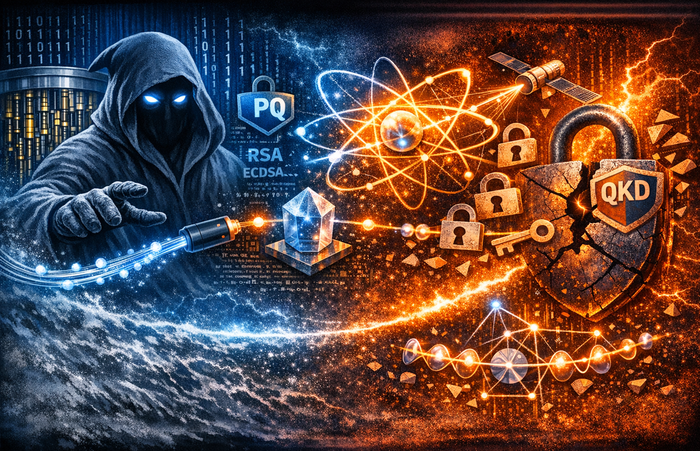
In conversations with prospective clients, the question of how to respond to the quantum threat increasingly centres on two terms: post-quantum cryptography (PQC) and quantum key distribution (QKD). The discussion is rarely abstract; it is grounded in immediate concerns about what organisations can do now, how existing security investments should evolve, and where emerging technologies such as QKD realistically fit into enterprise architectures. Despite being repeatedly linked in discussion, they are not equivalent answers to the same challenge and treating them as such can lead to misunderstanding.
Too often, PQC and QKD are positioned as competing or equivalent solutions, creating an artificial comparison that obscures their fundamentally different roles. This confusion is not just semantic. It leads directly to misallocated investment, poorly aligned architectural decisions, and security strategies that fail to address the underlying risk. What appears to be optionality is, in reality, a misunderstanding of how quantum-safe security must be constructed.
At its core, the distinction is straightforward. Post-quantum cryptography represents an evolution of classical cryptography, replacing vulnerable algorithms such as RSA and elliptic curve cryptography with new mathematical approaches designed to resist both classical and quantum attacks. Quantum key distribution, by contrast, does not replace cryptographic algorithms at all. Instead, it uses the principles of quantum mechanics to distribute encryption keys in a way that allows any interception attempt to be detected. One changes the mathematics. The other changes the physics.
This difference is not academic; it directly shapes how each technology can be deployed. PQC integrates into existing systems. It can be embedded into widely used protocols such as TLS, VPNs, and public key infrastructure, allowing organisations to upgrade security without redesigning their networks. It is a software-led transformation, aligned with how enterprises already operate. QKD, however, sits at the physical layer. It requires dedicated infrastructure, typically involving optical fibre or satellite-based communication channels, and is inherently constrained by distance, topology, and cost. Where PQC scales across entire digital estates, QKD applies to specific links.
The confusion deepens when considering what each technology actually secures. PQC protects data at rest, in transit, and across applications, by replacing the cryptographic primitives that underpin modern systems. QKD does something far narrower. It generates and distributes keys, but the data itself remains protected using conventional encryption. Authentication, identity, and application-layer security still rely on classical or post-quantum cryptographic mechanisms. In practical terms, QKD cannot stand alone; it depends on the very cryptographic systems it is often assumed to replace.
This is where the common narrative begins to break down. QKD is frequently described as “unbreakable” because it is based on physical laws rather than mathematical assumptions. While this is true within the confines of the quantum channel, it does not extend across the entire system. Real-world implementations still include devices, software, and operational processes, all of which remain vulnerable to traditional attack vectors such as side-channel exploits or implementation flaws. Security is never determined by a single component. It is determined by the integrity of the system as a whole.
Post-quantum cryptography, by contrast, is explicitly designed as a system-wide control. Its algorithms are subjected to extensive cryptanalysis and formal standardisation, and they integrate with existing governance, compliance, and assurance frameworks. This is why PQC is emerging as the primary response to the quantum threat. It is not because it is theoretically perfect, but because it is deployable, scalable, and aligned with real-world operating models. Organisations can begin migrating today, replacing vulnerable algorithms while maintaining continuity across applications and infrastructure.
When viewed through an enterprise lens, the distinction becomes even clearer. Modern organisations do not need to secure a handful of communication links; they need to secure complex, distributed ecosystems spanning cloud platforms, APIs, mobile devices, and partner networks. PQC addresses this reality by operating at the software and protocol level, where security can be applied consistently and at scale. QKD, in contrast, remains constrained to niche scenarios where highly controlled, point-to-point communication justifies the additional complexity and cost.
For this reason, framing the discussion as “PQC versus QKD” is fundamentally misleading. These technologies are not competing solutions. They operate at different layers and solve different problems. PQC provides a comprehensive response to the cryptographic risks introduced by quantum computing, while QKD offers a specialised method for strengthening key distribution in specific environments. Treating them as equivalents does not create optionality; it creates confusion.
The more useful perspective is one of architectural roles. PQC forms the foundation of quantum-safe security, providing broad protection across systems, applications, and data. QKD, where it is used, acts as a targeted enhancement, applied selectively to high-assurance links. Even in these cases, it cannot operate in isolation and must be paired with robust cryptographic controls for authentication and system integrity. The relationship is therefore complementary, but not symmetrical.
Ultimately, the greatest risk organisations face is not quantum computing itself, but responding to it incorrectly. Treating PQC and QKD as interchangeable obscures their true roles and leads to fragmented, ineffective strategies. The quantum threat demands clarity, not conflation. PQC provides the scalable, standards-based path to securing modern digital systems, while QKD remains a specialised tool for narrowly defined use cases. Understanding that distinction is not a matter of technical nuance; it is a prerequisite for building credible, defensible security architecture.
In a world where encrypted data is already being harvested for future decryption, getting this wrong does not delay risk, it compounds it.